News of the Week – October 30, 2026

This week’s issue is curated by Kara Morrow.  Kara is a Professor of Art History and Museum Studies at The College of Wooster.

Teaching & Learning

Don’t Worry About Professors’ Rules, AI Executive Tells Students (Delilah Brumer, Chronicle of Higher Education, October 22, 2026): AI tutoring company, which had partnered with the SUNY university, sent hundreds of students an email, raising concerns about faculty control over AI policies in their classrooms.

Overcome reading reluctance with in-class tasks (Noam Schimmel, University of California, Berkeley, Times Higher Education, October 22, 2026): “While no replacement for tackling long texts, short reading sessions build confidence, boost students’ learning and improve their analysis, synthesis and discussion.”

Campus Talks: Teaching strategies to get students reading and speaking up in class (David Gooblar, Eliza Compton, University of Iowa, Campus Talks by Times Higher Education [Podcast], October 22, 2026): Eyes need a break from the screen? Take a listen to this podcast with a thoughtful conversation on “ways to create more equitable classrooms, build students’ trust and support academic skills development.”

Connecting Through Chat ([John Kane &] Rebecca Mushtare, Center for Excellence in Learning and Teaching at SUNY Oswego talking with Greg Campbell, English Dept., Community College of Baltimore County, tea for teaching, October 21, 2026 [Podcast]): “Discussion boards in learning management systems, particularly in the age of AI, rarely capture the authentic voice of students. In this episode, Greg Campbell joins us to discuss how the use of a chat application can motivate conversation and build community.”

Budgets & Higher Ed’s Business Model: What They’re Reading & Saying “Off-Campus”

How College Leaders are Navigating Federal Pressures (Jeffrey Sonnenfeld and Stephen Henriques, Time Magazine, November 11, 2025): As someone who is deeply invested in understanding higher ed’s business model and the particular economic, political and cultural challenges we’re currently facing, I’m often surprised at the characterizations of our industry “off campus.” More and more frequently students call on faculty to explain these dynamics. This article appeared in Time Magazine almost one year ago and provides an interesting view into our experiences from the perspective of our students’ and their families.

The Business Model of College Is Broken. It’s About to Get Worse (Jeffrey Selingo, Time Magazine, July 2, 2026): Following up on the Time article above, this succinct follow up frames current circumstances and campus conversations, especially in light of additional federal pressures.

Tidbits: The Fate of College Teaching Collections

The Price of Closing a University Museum (Kathryn Palmer, Inside Higher Ed, October 26, 2026): Nearly all GLCA member colleges maintain formal art collections, and multiple institutions depend on academic, teaching-focused museums for pedagogical support. Yet academic museums across the U.S. are threatened. With a $2.4 million state budget cut looming, Fort Hays State University’s Sternberg Museum of Natural History was slated to close despite its  125-year history.

Fort Hays State Rescinds Natural History Museum Closure (Kathryn Palmer, Inside Higher Ed, October 28, 2026): Oh, wait! “Word of the Kansas university’s decision to close the Sternberg Museum of Natural History sparked community outrage. The reversal offers hope to others fighting to keep the Academy of Natural Science at Drexel alive.” 

Embarking on the Academy of Natural Sciences’ Next Chapter: Protecting a Legacy (Academy of Natural Sciences, September 25, 2026): “For more than two centuries, the Academy of Natural Sciences has helped people understand our natural world though its extraordinary collections, groundbreaking research and commitment to discovery and learning.” The public exhibitions are slated to close.

Preparing for the Election

There’s Still Time to Prepare for the Morning After Election Day (Nancy L. Thomas, Inside Higher Ed, October 26, 2026):  Consider this checklist for the days—and weeks—after.

Election Resources for Higher Education from the Constructive Dialogue Institute:  As November 3 approaches, CDI’s election resources offer practical guidance for campus leaders, faculty and staff, and civic engagement and dialogue centers. An on-demand webinar also features three administrators reflecting on what they learned preparing for 2024.

About the Art

Amy Karle, Hatcher, (Triceratops), Deep Time and the Far Future, 2020.

Artist Amy Karle created nine sculptures in two series examining the possibilities of reconstructive technologies and the potential and the pitfalls of future evolution that come with technological advancements. The sculptures are based on the 66-million-year-old Triceratops at the Smithsonian’s National Museum of Natural History, which made history as the first “digital dinosaur”—the first 3D scan of an entire dinosaur skeleton executed by the Smithsonian’s Digitization Program Office.”
News of the Week – October 16, 2026
This week’s issue is curated by Amy Jo Stavnezer. Amy Jo is a Professor of Neuroscience and Psychology at The College of Wooster.

Teaching & Learning

The problem with grades (Jessamyn Neuhaus, Ashley Cambareri & Cole Bailey, Tea for Teaching podcast, Aug 26. 2026). This podcast, again, asks us to consider the goals of traditional grading systems. The experts discuss the benefits of alterative grading, how they might help students focus more on learning than grades, and also invite students to share their experiences with different grading systems.

How Nicholas Ferroni is rewriting his classroom for human connection (Nicholas Ferroni,  School of Practice podcast, Aug 25, 2026). As a high school teacher, Ferroni discusses how he is trying, bit by bit, to take his classroom back to “before technology” days. This discussion aligns well with many recent posts on returning to oral exams, blue book exams, and digital free spaces that are popping up on many campuses. His message is completely applicable for college educators.

Career Readiness Needs an Architecture, Not an Add-On (James Devaney, Inside Higher Ed, Oct 15, 2026) Is your campus talking about career/world readiness, durable/transferable skills and a student population that knows how to relate those things to their future?  Mine is.  This article reminds us that readiness can, and should, come in a variety of forms, experiences and class years.

Self-Help opportunities, as we are nearly at mid-semester and you might be tired

How to be a realistic optimist (Mark Williamson, Action for Happiness, Sept 30, 2026). In this editorial, of sorts, the author invites us to find ways each day to see goodness around us, but also recognizes the reality of forced optimism.  By combining these ideas, he suggests options for being a realistic optimist by being real in the process of finding the good.  Might be a nice read for a small pick-me-up at this crunch time of the semester.

Who are you when you teach? (Elysia Sokolenko & Matthew Arnold, Times Higher Education, Oct 14, 2026). “As we cultivate our educator identity, we lay the foundation for the transition from being a professional who teaches to a teaching professional.” The authors ask us to consider how our educator and non-educator lives align and how we might consider blending our identities with a set of 3 recommendations to consider.

Why care for faculty and staff in higher education is critical (Tracie Addy, Care in the Academy, Apr 13, 2026). Addy shares with us her experiences in needing and building care structures in higher education institutions. Perhaps some of her ideas can spark needed change for you, your department or division, or even your whole college. 

NEXT WEEK:  CTL Event with Lindsay Masland  

Over the past few years, college instructors have been surprised, confused, and occasionally outraged by the students who show up in our classrooms. Lamentations over missing skills, low attendance rates, and disappointing work quality are centerstage in many pedagogical discussions. Not surprisingly, the recommended antidote is to double down on the use of student-centered teaching.  In the quest to be student-centered, though, we can end up making choices that can overwhelm us with their unsustainability.  Does this sound familiar?  If so, join us:  

A Permission Slip to Say No:
Sustainable Teaching in Unsustainable Conditions

with Lindsay Masland

Lindsay is the Executive Director for the Center for Excellence in Teaching and Learning for Student Success and a Professor in the Department of Psychology at Appalachian State University.   Register HERE for the event on Thursday, October 22, 2026 at Noon EST.  

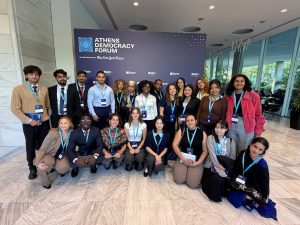
GLCA/GLAA Students Participate in Athens Democracy Forum (pictured below)

For the 10th year, the GLCA/GLAA had the opportunity to bring an all-star student delegation to participate in the Athens Democracy Forum Sept 29-Oct 1, 2026.  Students interviewed journalists, scholars, leaders of NGOs, politicians and others and produced videos that were shown during the Forum.

Front Row (L-R):  Maria Eduarda Arêdes Brasil de Mendonça (Saint Mary’s College), Prince David Dwamena (Allegheny College), Daria Minhas (American University of Paris), Sofia Stefanova Mihaylova (American University of Paris), Sayoko Yamada (International Christian University), Leylany Rivera (Saint Mary’s College), Rise Saiki (International Christian University), María Alejandra Núñez Padilla (University San Francisco de Quito)

Back Row (L-R):  Noufil Asif (Albion College), Yogesh Kumar Gupta (Allegheny College), Inderias Samson (Forman Christian College), Karam Ezzeddin (American College of Greece), Clarady Brooks (Oberlin College), Sara Filali (Al Akhawayn University), Willona Asare Ayesu (The College of Wooster), Rhennystella Anthony Wankya (Franklin University Switzerland), Madeleine Barbar (Kenyon College), Rebeca Silva Sucilla (Franklin University Switzerland), Thelma Reyes (Hope College), Nour Al-Tzaratli (American College of Greece), Jenny Yakarta Perez Alejandres (Earlham College), Eshaa Setty (FLAME University)

Thank you to the American College of Greece for the warm hospitality! The first two pictures above are from the student’s visit to the Acropolis and the last is on site at the Forum in the Athens Conservatoire.  

Editor:  Colleen Monahan Smith, GLCA, smith@glca.org

News of the Week – October 2, 2026

This week’s issue is curated by Amy Jo Stavnezer. Amy Jo is a Professor of Neuroscience and Psychology at The College of Wooster.

Teaching & Learning
Don’t Wave the White Flag on Reading Just Yet (Austin Sarat, Inside Higher Ed, Aug 7, 2026)  Austin Sarat suggests that we stop assuming students know that reading is a good thing, and being frustrated when they don’t do it, and instead help them build not only the skill but an understanding of what that skill provides.

Are Office Hours Pointless? (Tim Franz & Lauren Vicker, Inside Higher Ed, Aug 26, 2026)  Here the authors argue that office hours can still be successful and helpful, if we alter our practices a bit to better meet our students where they are.  They provide 5 easy to incorporate suggestions to make students feel more welcome and, hopefully, to increase their use of this important opportunity.

What Five Years of Listening to Students Taught Us About Learning (Amanda Ervin interviews Chris Gallagher, Kristi Girdharry and Kevin Smith, Dead Ideas in Teaching and Leanring Podcast, September 17, 2026).  This podcast welcomes three faculty who overview the research they present in their recent book Getting Learning Right. They discuss what a group of undergraduates do know about learning, opportunities, and experiences and also how gathering this knowledge helped these faculty shift their own pedagogical practices.

Trending Tips – Alternative Assessments 
Still considering alternative ways to assess knowledge, critical thinking, and understanding outside of a written exam or paper? Try some of these ideas that follow-up on the Return of the Oral Exam post from 9/18 NoTW

The Teaching Newsletter (Beth McMurtie, Chronicle for Higher Education, Sept 24, 2026)  Discussion, Graded presents a clear application of scaffolding peer engagement and communication which then becomes a small group graded discussion twice in the semester. While the group is talking, the professor is assessing: professionalism, understanding of the course material, and critical engagement.

The Teaching Newsletter (Beth McMurtie, Chronicle for Higher Education, Sept 10, 2026)  This post draws together several benefits and implementation strategies for oral exam. Examples come from a variety of fields and additional resources are embedded.

I’m a College Professor. Writing Isn’t as Important as We Think (Joe Cruz, NYTimes, Sept 29, 2026).  In this opinion piece, Joe Cruz argues that we might do better to return to oral exams to truly assess what a student understands and how they are able think and reason. He recognizes the impact of AI, believes that we can work with it, and suggests that writing assignment provide a convenient grading mechanism for faculty, but that it might not be the best was to assess thinking.

Tidbits

Short snippets by AAC&U Liberal Education editors to inspire, engage and maybe bring a smile.  Good Morning (Summer 2026) provides personal notes on what wakes educators up and motivates them every day; a moment of Snoop Dogg Affirmations, anyone?

Free to Imagine (Spring 2026) asks what you would do if barriers magically disappeared. There are some aspirational, if lofty, ideas here that could really make a difference. Wondering how we could implement just one part.

When Delight is the Goal (Winter 2026) offers simple ideas to excite students in their learning.If you like these ideas, take a look at this Edutopia piece as well.

Editor:  Colleen Monahan Smith, GLCA, smith@glca.org

News of the Week – September 18, 2026

This week’s issue is curated by Jen Adams. Jen is the Assistant Dean for Academic Projects and Chair/Professor of Communication and Theatre at DePauw University.                                                       

Teaching & Learning

The Return of the Oral Exam (Beth McMurtrie, The Chronicle of Higher Education, September 2, 2026): Prompted by concerns about AI, faculty are rediscovering oral examinations, and finding that they can encourage deeper learning, authentic assessment, and stronger faculty-student interaction.

Teaching Controversial Topics When Information is Incomplete (Ahlam Lee, Inside Higher Ed, September 15, 2026): Offers practical strategies for helping students move beyond emotional reactions to unfolding controversies by slowing down discussion, examining bias, distinguishing among types of claims, and expanding context before reaching conclusions.

The Power of Prequestioning (Michelle D. Miller, R3 Newsletter, September 8, 2026): Drawing on recent research in cognitive psychology, Miller explores how asking students questions before they encounter new material can focus attention and improve learning, offering faculty a simple, low-stakes strategy for helping students engage with challenging readings.

Student Connection & Belonging in the Classroom

Learning and Being: Building Belonging Through Relational Teaching Practices (Brianne Morettini, Belonging, July 14, 2026): Examines how relational teaching practices, including seeking student input, demonstrating care, and treating students as co-creators of the learning experience, can foster students’ sense of belonging, well-being, and engagement in the classroom.

Belonging Should Not Mean Only That Students Feel Welcome (Sunah Cho, Times Higher Education Campus, September 14, 2026): Drawing on universal design for learning, Cho offers practical ways to move beyond simply making students feel welcome toward creating classrooms where all students can participate meaningfully in the learning experience.

The Liberal Arts in Practice

How the Liberal Arts Became Countercultural (and Essential) in the Age of AI (Deseree Probasco, Jason Gulya, and Bethany Smith, EDUCAUSE Shop Talk, June 1, 2026): Explores how liberal arts capacities such as critical thinking, curiosity, imagination, and the ability to translate between technical and nontechnical worlds become increasingly valuable in an age shaped by artificial intelligence.

Memorable Teaching Doesn’t Just Transfer Knowledge – It Transforms Perspective  (Andrew Gipe-Lazarou, Times Higher Education Campus, September 15, 2026): Explores how authentic learning experiences can move students beyond disciplinary knowledge toward deeper perspective, professional judgment, and a stronger sense of responsibility.    

GLCA is hiring!

The GLCA is hiring a Senior Program Director to help lead collaborative academic and administrative initiatives across our thirteen liberal arts colleges. This hybrid role is an opportunity for an experienced faculty or faculty-adjacent administrator to convene faculty and academic leaders, strengthen professional development and leadership programs, and help institutions respond creatively to a changing higher education landscape. Review of applications begins October 30, 2026.  More information about the position and the application process can be found here.


Editor:  Colleen Monahan Smith, GLCA, smith@glca.org

News of the Week – September 4, 2026

This week’s issue is curated by Zachary Adams. Zach is the Assistant Director, Center for Teaching and Learning and Instruction Specialist at Hope College.

Teaching and Learning

Rethinking Course Design to Enliven Student Engagement (Nasreen Sultana, Times Higher Education Campus, August 20, 2026): Sultana offers four practical strategies for making in-person class time more interactive, relevant, and clearly connected to assessment.

Are Office Hours Pointless? (Tim Franz and Lauren Vicker, Inside Higher Ed, August 26, 2026): Franz and Vicker argue that office hours still matter, but faculty may need to rethink how, when, and why they invite students to use them.

A Four-Step Writing Protocol to Teach Students How to Practise Attention (Leonard Nalencz, Times Higher Education Campus, August 27, 2026): Nalencz shares a simple classroom protocol that combines rereading, writing, reflection, and conversation to help students practice sustained attention and close reading.

Today’s Students

What New Research Reveals About Student Success (Joshua Bay, Inside Higher Ed, August 18, 2026): Recent research on mental health, financial vulnerability, campus resources, neurodiversity, and career preparation challenges assumptions about what students need to persist and succeed.

Tech-ish

Student’s Perception of UX Design on an LMS Course: Designing Online Courses Students Can Actually Navigate (Mark Savignano and Scott Page, Faculty Focus, August 10, 2026): A useful reminder that LMS design is part of course design: clear navigation, consistent organization, and accessible layouts can reduce frustration and help students focus on learning.

Top Tools for Learning 2026, with Dave Stachowiak (Bonni Stachowiak and Dave Stachowiak, Teaching in Higher Ed, August 27, 2026): Bonni Stachowiak shares her current top tools for learning and the “seek-sense-share” practice behind them, offering faculty a useful way to think about how digital tools support their own learning and teaching.

Tidbits

A Classroom in Concert: How to Design a Truly Rockin’ Learning Experience (Teresa Thompson, Faculty Focus, August 21, 2026): Thompson draws parallels between a well-designed concert and a well-designed class, highlighting how intentional openings, sequencing, storytelling, and use of space can create a more engaging learning experience.

What Students Know About College That Critics Don’t (opinion) (Richard Detweiler, Inside Higher Ed, September 2, 2026): Detweiler, former president of the GLCA and author of The Evidence Liberal Arts Needs: Lives of Consequence, Inquiry, and Accomplishment (MIT Press, 2021) argues that we must continue to create relational, intellectually stretching, community-embedded experiences to produce not just capable workers, but citizens, leaders and contributors to the larger human project.

GLCA is hiring!

The GLCA is hiring a Senior Program Director to help lead collaborative academic and administrative initiatives across our thirteen liberal arts colleges. This hybrid role is an opportunity for an experienced faculty or faculty-adjacent administrator to convene faculty and academic leaders, strengthen professional development and leadership programs, and help institutions respond creatively to a changing higher education landscape. Review of applications begins October 30, 2026.  More information about the position and the application process can be found here.


Editor:  Colleen Monahan Smith, GLCA, smith@glca.org

News of the Week – Aug 21, 2026

This week’s issue is curated by Sergio Gutiérrez Negrón. Sergio is Director of The Gertrude B. Lemle Center for Innovation and Excellence in Teaching and Scholarship and Associate Professor of Hispanic Studies at Oberlin College. 

Teaching & Learning

How to Teach a Good First Day of Class (James M. Lang, Chronicle of Higher Education, Aug 21, 2018). An oldie but a goodie: in this piece, Lang offers a feel-good and helpful guide to the first day of classes (looming for a big chunk of us). He opens with principles for day one that, semester in and semester out, I find affirming: lead with curiosity and learning, humanize yourself and your students, set up course expectations.

What Do You Know? Judging Your Own Learning Doesn’t Always Improve It. (Michelle Miller, Substack, August 03, 2026). In this piece, Miller surveys recent research that tests whether learning self-checks lead to improvement (it doesn’t), and concludes that deliberate teaching of material and explicit retrieval activities are the way to go. Interestingly, this piece echoes many other recent research articles (and Substack rewrites) that is starting to insist that growth mindsets and metacognition is all good and intuitive, but without good research proven pedagogical practices (retrieval, spacing, etc) it yields very little beyond vibes.

Just-In-Time Assessment Strategies for Lasting Learning (Joshua D. Morrison, National Teaching and Learning Forum, April 07, 2026). Last semester, I found this article useful to remind myself to integrate small real-time, in-class checks to gauge student understanding and adjust learning before things got too bad. I promised myself I would re-read it to have it in my toolkit this semester.

Tech-ish

Against Optimized Efficiency: Why Foreign Language Learning Still Matters  (Kit Pribble, Critical AI, April 1, 2026). The author argues that language is not code, like functionalists often believe. As all of us language teachers know, language proficiency entails an engagement with and openness that” lies in the capacity to engage meaningfully and intentionally with the target language, with a full understanding of the social and cultural beliefs and practices that language articulates”.

The Psychology of Technology: The Science We Need in the Age of AI (Nathanael Fast and Juliana Schroeder, Designing Tomorrow, June 3, 2026). The authors reflect on a decade leading the Psychology of Technology Institute, and warn that, as generative AI rapidly scales, developers must avoid pushing for optimization at the risk of eroding attention, trust, and mental health. They share their Institute’s framework for an interdisciplinary research program paired with proactive ethical interventions—including public tracking indices, ethical design standards, and evidence-backed policy.

Around the GLCA

In case you missed it, here is the recording of the most recent GLCA CTL program, Right on Time or Just in Time: Welcoming Students into Class with Larry Chavis (Kalamazoo College), Cory Christenson (Washington & Jefferson College) and Lew Ludwig (Denison University).  Watch the recording and learn about strategies your colleagues have tried for beginning class in ways that help students feel welcome, engaged, and accountable to one another.

Editor:  Colleen Monahan Smith, GLCA, smith@glca.org